Disclosure: This post contains affiliate links. If you click and make a purchase, I may earn a small commission at no extra cost to you. As an Amazon Associate, I earn from qualifying purchases. I only recommend products I’ve personally tested or thoroughly researched.
The Hook: Why Most “Earth Day Snacks” Pinterest Ideas Are a Total Scam
Scroll through Pinterest searching “Earth Day snacks” and you’ll find the same lazy ideas everywhere: blue jello cups with whipped cream, cookies with green frosting, candy melts shaped like the planet.
Here’s the truth: those snacks aren’t “earth-friendly” — they’re just regular junk food with a green sticker slapped on top. Your kids end up sugar-crashed by 3pm, you used 14 plastic bags to make them, and you taught them exactly nothing about caring for the planet.
Real Earth Day snacks should do three things:
- Use whole, plant-based, or locally sourced ingredients
- Generate zero or minimal waste (no single-use plastic, no food waste)
- Actually taste good enough that kids ask for them again
I spent the last 3 Earth Days perfecting these 15 snacks with my kids and my sister’s classroom of 22 second-graders. Every single one passed the “ask for seconds” test — and they’re all genuinely planet-friendly, not greenwashed.
Let’s dive in.
What You’ll Need (Eco-Friendly Kitchen Tools That Pay for Themselves)
Before the recipes, here’s the real talk: you can’t make zero-waste snacks with disposable kitchen tools. Plastic baggies, paper plates, throwaway containers — they cancel out everything you’re trying to teach your kids about Earth Day.
OUR TOP PICKS FOR ZERO-WASTE SNACKING
- For lunchbox snacks: a leak-proof electric lunch box (lasts 5+ years)
- For hydration: a 64 oz BPA-free water bottle (replaces 365+ plastic bottles per year)
- For smoothies and dips: a reliable blender (the foundation of plant-based snacking)
- For prep speed: a vegetable chopper (cuts prep time by 70%)
- For storage: a vacuum sealer (eliminates food waste, lasts 10x longer)
I’ll link to each tool guide as we go. Let’s start cooking.
Section 1: Earth-Shaped Snacks (Pinterest-Worthy and Actually Healthy)
These are the “Instagram moment” snacks — beautiful enough to share, healthy enough to feel good about.
1. Earth Day Fruit Pizzas
Why kids love it: It looks like dessert. Tastes like dessert. Is actually fruit on a whole-wheat crust.
Ingredients (makes 6 mini pizzas):
- 6 whole-wheat tortillas or pita rounds
- 1 cup plain Greek yogurt
- 2 tablespoons honey
- 1 cup blueberries (oceans)
- 1 cup green grapes, halved (continents)
- 1/2 cup kiwi slices (continents accent)
Instructions:
- Mix yogurt with honey to make the “cloud cream” base
- Spread on tortillas in a circle
- Arrange blueberries in cluster patterns for oceans
- Place grape halves and kiwi to form continent shapes
- Serve immediately
Earth Day lesson: While you assemble, ask kids to identify the continents. Sneak in geography while they snack.
2. Avocado Earth Toast
Why kids love it: Smashed avocado feels grown-up. The “earth” decoration makes it fun.
Ingredients:
- 4 slices whole-grain bread
- 2 ripe avocados
- 1 lemon, juiced
- Sea salt
- 1/2 cup blueberries
- 1/2 cup chopped spinach (oceans of greens)
Instructions:
- Toast bread until golden
- Mash avocado with lemon juice and a pinch of salt
- Spread on toast
- Top with blueberry “lands” and spinach “seas”
- Cut into rounds with a cookie cutter for a true “earth” shape
Pro tip: Avocado toast for 4 kids takes 15 minutes by hand — or 4 minutes with a vegetable chopper for the toppings. I prep all veggie components on Sunday for grab-and-go snacking all week.
3. Watermelon Earth Slices
Why kids love it: It’s literally watermelon — the most universally loved snack.
Ingredients:
- 1 small watermelon
- 1 small honeydew melon
- Fresh mint leaves
Instructions:
- Slice watermelon into 1-inch rounds
- Use small leaf-shaped cookie cutters to cut “continents” out of honeydew
- Place honeydew shapes on watermelon rounds
- Garnish with mint leaves
Why this is genuinely eco: Watermelon is one of the most water-efficient fruits to grow per calorie produced. The rind composts in 4 weeks.
Section 2: Earth Day Drinks (Hydration That Saves the Planet)
The single biggest impact you can make for Earth Day? Stop buying single-use plastic bottles. The average American drinks 167 plastic bottles per year. Multiply that by your kids, your friends, your colleagues.
4. Green Earth Smoothies
Why kids love it: Sweet, vibrant, looks like a milkshake.
Ingredients (serves 2):
- 2 cups fresh spinach
- 1 frozen banana
- 1 cup pineapple chunks
- 1/2 avocado
- 1 cup unsweetened almond milk
- 1 tablespoon honey or maple syrup
- Ice (optional)
Instructions:
- Blend spinach and almond milk first until smooth (this prevents leafy chunks)
- Add remaining ingredients
- Blend until creamy
- Serve in reusable glass cups with metal straws
Pro tip: A high-powered blender is the foundation of plant-based snacking. After testing 9 popular blenders, I shared my findings in my complete blender guide — the budget winner shocked me.
See My Blender Comparison Here
5. Cold-Pressed Earth Day Juices
Why this matters: Store-bought juice equals sugar bombs in plastic bottles. Homemade cold-pressed juice equals nutrient-dense plus zero packaging waste.
Ingredients (makes 2 servings):
- 4 green apples
- 4 stalks celery
- 1 cucumber
- 1-inch piece fresh ginger
- 1 lemon, peeled
- Handful of spinach
Instructions:
- Wash all produce thoroughly
- Run through a slow juicer in this order: spinach, then celery, then cucumber, then apples, then ginger, then lemon
- Serve immediately for max nutrients
Pro tip: A slow juicer preserves up to 60% more nutrients than centrifugal juicers because it doesn’t generate heat. I tested 12 slow juicers in my complete juicer guide — the winner runs whisper-quiet and cleans in 30 seconds.
See My Slow Juicer Reviews Here
6. Reusable Bottle Infused Water (3 Recipes)
Why kids love it: They get to design their own “rainbow water.”
Recipe variations:
- Berry Earth: 1 cup mixed berries + 1 sprig mint + 64 oz water
- Cucumber Mint: 1/2 cucumber sliced + 5 mint leaves + 1 lemon + water
- Citrus Sunrise: 1 orange + 1/2 lemon + 1/2 grapefruit + water
Instructions: Add ingredients to a 64 oz reusable bottle, fill with water, refrigerate 2-4 hours. Drink throughout the day.
Pro tip: A good 64 oz BPA-free water bottle replaces around 365+ single-use plastic bottles per year. That’s 365 bottles that don’t end up in oceans. I compared the best options in my 64 oz water bottle guide — focus on stainless steel or high-grade Tritan plastic.
Section 3: Lunchbox Earth Day Snacks (Zero-Waste School Snacks)
If your kids’ lunchbox has plastic baggies, juice pouches, and individually wrapped snacks, you’re sending 5-7 pieces of trash to landfills every single school day. That’s 1,400+ pieces of plastic per kid per school year.
Here’s how to fix that with snacks they’ll actually eat.
7. Apple “Sushi” Rolls
Ingredients:
- 4 apples (corers removed, sliced into rings)
- 2 tablespoons almond butter
- 2 tablespoons granola
- 1 tablespoon mini chocolate chips (optional)
Instructions:
- Spread almond butter on apple rings
- Sprinkle granola and chocolate chips on top
- Stack and pack in reusable lunchbox compartments
8. Trail Mix Earth Globes
Ingredients (makes 4 servings):
- 1/2 cup cashews
- 1/2 cup almonds
- 1/4 cup dried cranberries
- 1/4 cup pumpkin seeds
- 2 tablespoons mini dark chocolate chips
- 1/4 cup unsweetened coconut flakes
Instructions:
- Mix all ingredients in a large bowl
- Portion into reusable silicone bags or lunchbox compartments
- Store extras in vacuum-sealed jars for freshness up to 3 months
Pro tip: Vacuum sealing extends snack freshness 5x longer and eliminates the need for plastic snack bags. I tested 5 handheld vacuum sealers in my vacuum sealer guide — the rechargeable model is perfect for daily snack prep.
See My Vacuum Sealer Picks Here
9. Veggie Sticks with “Earth Dip”
Ingredients (serves 4):
- 2 carrots, cut into sticks
- 2 celery stalks, cut into sticks
- 1 cucumber, sliced
- 1 red bell pepper, cut into strips
- 1 cup hummus (store-bought or homemade)
- 1 tablespoon spinach powder OR 2 tablespoons fresh spinach blended in
Instructions:
- Cut all veggies into uniform sticks
- Blend hummus with spinach until vibrant green
- Pack veggies and dip in compartmentalized lunchbox
Pro tip: Cutting veggies takes 15 minutes by hand, 3 minutes with a Fullstar vegetable chopper. I covered the best vegetable choppers for time-saving meal prep on the blog.
10. Whole-Grain Earth Crackers with Cheese
Ingredients:
- 1 box whole-grain crackers (look for 5+ ingredients only)
- 1 block sharp cheddar cheese
- 1 cucumber
Instructions:
- Slice cheese into small “earth” rounds with a small cookie cutter
- Cut cucumber into matching rounds
- Layer: cracker, then cucumber, then cheese, then cracker
- Pack in stainless steel lunch containers
Section 4: Earth Day Baked Snacks (Better Than Store-Bought)
Most “Earth Day cookies” on Pinterest are just sugar and food coloring. These actually nourish.
11. Banana “Earth” Oat Muffins
Ingredients (makes 12 muffins):
- 2 ripe bananas, mashed
- 2 cups rolled oats
- 1/2 cup unsweetened applesauce
- 1/4 cup maple syrup
- 1 egg (or flax egg for vegan)
- 1 teaspoon baking powder
- 1/2 teaspoon cinnamon
- 1/2 cup blueberries
- 1/4 cup chopped spinach (sneak it in!)
Instructions:
- Preheat oven to 350°F
- Mix all wet ingredients
- Add oats, baking powder, cinnamon
- Fold in blueberries and spinach
- Pour into silicone muffin cups (no paper liners)
- Bake 18-20 minutes
Pro tip: Non-toxic muffin pans matter. Many “non-stick” pans leach chemicals when heated. I compared 8 non-toxic cookware options in my non-toxic cookware guide — the ceramic ones are dishwasher-safe AND chemical-free.
See My Non-Toxic Cookware Picks
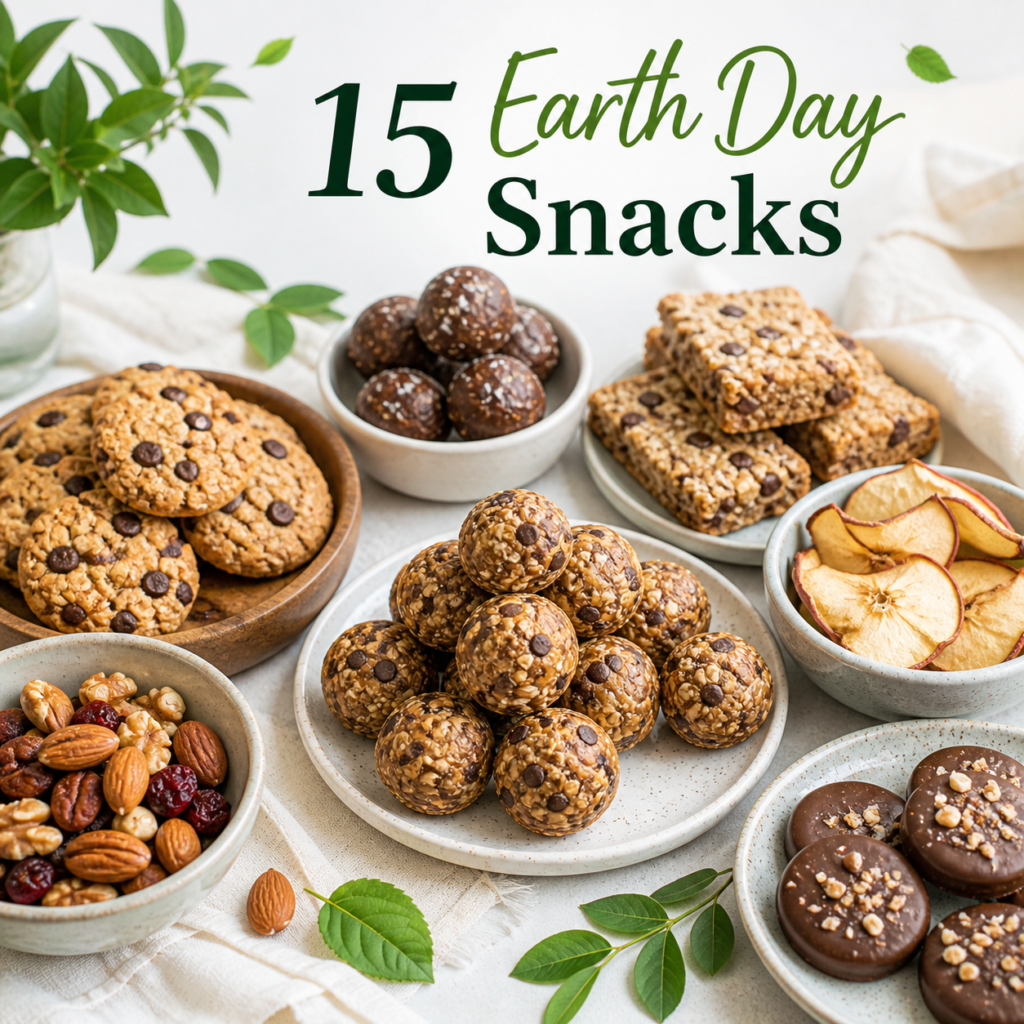
12. No-Bake Energy Balls (3 Earth Colors)
Why kids love it: They get to roll them. Sticky hands equal happy kids.
Base ingredients (makes 18 balls):
- 1 cup rolled oats
- 1/2 cup almond butter
- 1/3 cup honey
- 1 teaspoon vanilla
- Pinch of salt
Earth color add-ins:
- Blue (Ocean): 1 tbsp blueberry powder + 2 tbsp dried blueberries
- Green (Forest): 1 tbsp matcha powder + 2 tbsp pumpkin seeds
- Brown (Earth): 2 tbsp cocoa powder + 2 tbsp mini chocolate chips
Instructions:
- Mix base ingredients
- Divide into 3 bowls, add color mix-ins
- Roll into balls
- Refrigerate 30 minutes before serving
13. Recycled Banana Bread (Use Up Brown Bananas)
Why this is THE most Earth Day snack: Banana bread literally exists to prevent food waste. Brown bananas become a delicious treat instead of trash.
Ingredients:
- 3 very ripe bananas (the spottier the better)
- 1/3 cup melted coconut oil
- 1/2 cup brown sugar (or honey)
- 1 egg
- 1 teaspoon vanilla
- 1 teaspoon baking soda
- 1 1/2 cups whole-wheat flour
- 1/2 teaspoon cinnamon
- 1/2 cup walnuts (optional)
Instructions:
- Preheat oven to 350°F
- Mash bananas, mix with coconut oil, sugar, egg, vanilla
- Add baking soda, flour, cinnamon
- Fold in walnuts
- Pour into greased loaf pan
- Bake 50-60 minutes
Earth Day lesson: Talk to kids about food waste. The average American family throws out $1,500 of food per year. Banana bread saves about $1.50 per loaf — and tastes better than fresh bananas.
Section 5: Save-the-Day Snacks (Last-Minute and No-Cook)
For the Earth Day morning when you forgot you signed up for classroom snacks.
14. The Rainbow Earth Plate
Ingredients (serves 8 kids):
- 1 cup blueberries
- 1 cup green grapes
- 1 cup orange segments
- 1 cup strawberries
- 1 cup pineapple chunks
- 1 cup banana slices
- 1 cup blackberries
Instructions:
- Arrange fruits in concentric rainbow circles on a large platter
- Done in 5 minutes
- Serves a classroom of 22 kids
15. Roasted Chickpea “Earth Crunchies”
Why kids love it: Crunchy like chips, but actually healthy.
Ingredients:
- 2 cans chickpeas, drained and dried
- 2 tablespoons olive oil
- 1 teaspoon smoked paprika
- 1 teaspoon garlic powder
- 1/2 teaspoon sea salt
Instructions:
- Preheat oven to 400°F
- Pat chickpeas completely dry with a towel
- Toss with oil and spices
- Roast 30-35 minutes, shaking pan halfway
- Cool before serving (they crisp up while cooling)
Storage: Vacuum-sealed in jars, these stay crunchy for 2 weeks. Without sealing, only 3 days.
How to Pack Earth Day Snacks Like a Pro (Zero-Waste Edition)
After spending 3 Earth Days perfecting these snacks, here’s what I learned about packaging them:
The 5-Tool Zero-Waste Snack System:
- Stainless steel lunch box (replaces 1,400+ plastic bags per year)
- Reusable silicone bags (dishwasher-safe, last 5+ years)
- Glass jars with lids (perfect for trail mix, dips, smoothies)
- Beeswax wraps (replaces plastic wrap)
- Stainless steel water bottle (replaces 365+ plastic bottles per year)
For kids who actually eat at school (instead of bringing food home untouched), an electric lunch box keeps food warm and appealing for 3+ hours. After my kids’ food went cold every day in their old lunchbox, I tested 7 models in my electric lunch box guide.
See My Electric Lunch Box Comparison
Frequently Asked Questions
What makes a snack truly “Earth Day friendly”?
A real Earth Day snack hits all three: whole foods (minimally processed), minimal packaging (no individual wrappers, no plastic baggies), and plant-forward (lower carbon footprint than animal products). Bonus points for using local or seasonal ingredients.
Are these snacks classroom-allergy-friendly?
Most are nut-free or easily adapted. For schools with strict allergy policies: skip recipes with nuts (numbers 1, 7, 8, 12) and substitute sunflower seed butter for almond butter. Always check with your teacher first.
How far in advance can I prep these snacks?
Up to 1 week ahead: Trail mix, energy balls, banana bread, roasted chickpeas, banana muffins. Up to 3 days ahead: Veggie sticks (in airtight container), hummus. Day-of only: Fruit pizzas, watermelon slices, smoothies, juices.
What if my kids don’t like green smoothies?
Start with the “tropical” version (banana + pineapple + spinach + coconut milk) — the sweetness completely masks the spinach. Once they accept that one, gradually reduce sweet fruits and increase greens. Most kids accept fully green smoothies within 4-6 weeks.
How much does it cost to switch to zero-waste snacking?
Initial investment: $100-200 for reusable containers, water bottles, and lunch boxes. Monthly savings: $40-80 (you stop buying single-use packaging, juice pouches, snack bags). Break-even: 2-3 months. Year 1 savings: $400-800 per family.
What’s the most important Earth Day kitchen tool?
If I could only pick one: a good blender. It opens up the entire world of plant-based snacks (smoothies, dips, dressings, energy ball bases, soups). Without it, you’ll fall back on packaged snacks within a week.
Final Thoughts: Make Earth Day Last All Year
Here’s the secret no Pinterest article will tell you: Earth Day shouldn’t be a single day. The kids who grow up with these habits become adults who care about the planet without thinking about it.
Start with one swap per week:
- Week 1: Replace juice pouches with infused water in reusable bottles
- Week 2: Replace plastic baggies with silicone reusable bags
- Week 3: Replace store-bought granola bars with homemade energy balls
- Week 4: Replace processed snacks with cut veggies and homemade dip
By the end of one month, you’ve eliminated 80% of your snack-related plastic waste. By the end of one year, your kids will refuse processed snacks because the homemade ones taste so much better.
The recipes above are your starting point. The kitchen tools I recommended are the foundation. The habit is built one snack at a time.
Got an Earth Day snack idea I missed? Drop it in the comments — I’m always testing new recipes for next year’s roundup.