Disclosure: This post contains affiliate links. If you click and purchase, I may earn a small commission at no extra cost to you. I only recommend products I have personally tested and genuinely believe in. — Mia
If you’re serious about fresh juice — whether that’s grapefruit juice every morning, lime juice for cocktails, or nutrient-packed vegetable blends — you’ve probably realized that not all juicers are built for the same job.
After testing every type of juicer in my kitchen over the past year, I can tell you that the cast iron juicer is one of the most underrated tools in the juicing world. It’s fast, silent, produces outstanding pressed juice, and requires almost no cleanup. Combined with the right cold press juicer machine for vegetables and greens, you can cover every juicing need you’ll ever have.
In this guide, I’m covering all four products I recommend — two cast iron juicers, one cold press juicer machine, and one centrifugal option — with honest pros, cons, and a clear verdict on which one fits your lifestyle.
All Juicers Compared — Quick Reference Table
| Product | Type | Best For | Price | Link |
|---|---|---|---|---|
| Zulay Kitchen Cast Iron Juicer | Cast iron manual press | Lime juice, grapefruit juice, daily citrus | ~$45 | Check on Amazon |
| Commercial Cast Iron Juicer — Grapefruit & Citrus | Cast iron commercial press | Heavy grapefruit juice, high-volume citrus | ~$55 | Check on Amazon |
| 5.3″ Large Feed Chute Cold Press Juicer | Cold press juicer machine | Vegetables, greens, mixed fruits, slow juicer | ~$200 | Check on Amazon |
| Centrifugal Juicer | Centrifugal | Quick fruit juice, occasional use | ~$60–$100 | Check on Amazon |
What Is a Cast Iron Juicer — and Why Does It Produce Better Citrus Juice?
A cast iron juicer is a manual hand-press citrus extractor. Unlike electric juicers, it works entirely by leverage — you cut your citrus in half, place it cut-side down on the cone, pull the handle, and you have pure, freshly pressed juice in under 5 seconds.
No motor. No electricity. No oxidation from spinning blades. Just direct mechanical pressure that extracts every drop of juice while leaving seeds and pulp completely behind.
I started using a cast iron juicer for my morning lime juice routine about 18 months ago, and I genuinely haven’t looked back. For citrus specifically — grapefruit juice, lime juice, lemon juice, orange juice — a cast iron press produces better results than any electric juicer at any price. Here’s why:
Silent operation — perfect for early mornings without waking anyone
Zero heat — cold mechanical pressing preserves vitamins and enzymes completely
Maximum extraction — the leverage mechanism extracts 30–40% more juice than handheld squeezers
No oxidation — no spinning blades means no air introduced into the juice
Instant cleanup — rinse under water, done in 30 seconds
Cast Iron Juicer #1 — Zulay Kitchen Cast Iron Juicer

- SQUEEZE OUT EVERY DROP OF JUICE: Our lemon squeezer won’t waste even a single drop from your favorite fruit and will als…
- SAVE TIME AND EFFORT: Our citrus juicer makes juicing easy-peasy lemon squeezy. The comfortable grip handle allows you t…
- STURDY AND DURABLE MATERIAL: This manual juicer is made of heavy-duty cast iron that can easily withstand the pressure f…
- EASY TO CLEAN AND SAFE TO USE: Focus more on extracting fresh fruit juice than worrying about cleaning up. All parts of …
- HASSLE-FREE ZULAY GUARANTEE: We love and take our pomegranate juicer and back it up with a lifetime guarantee. Have the …
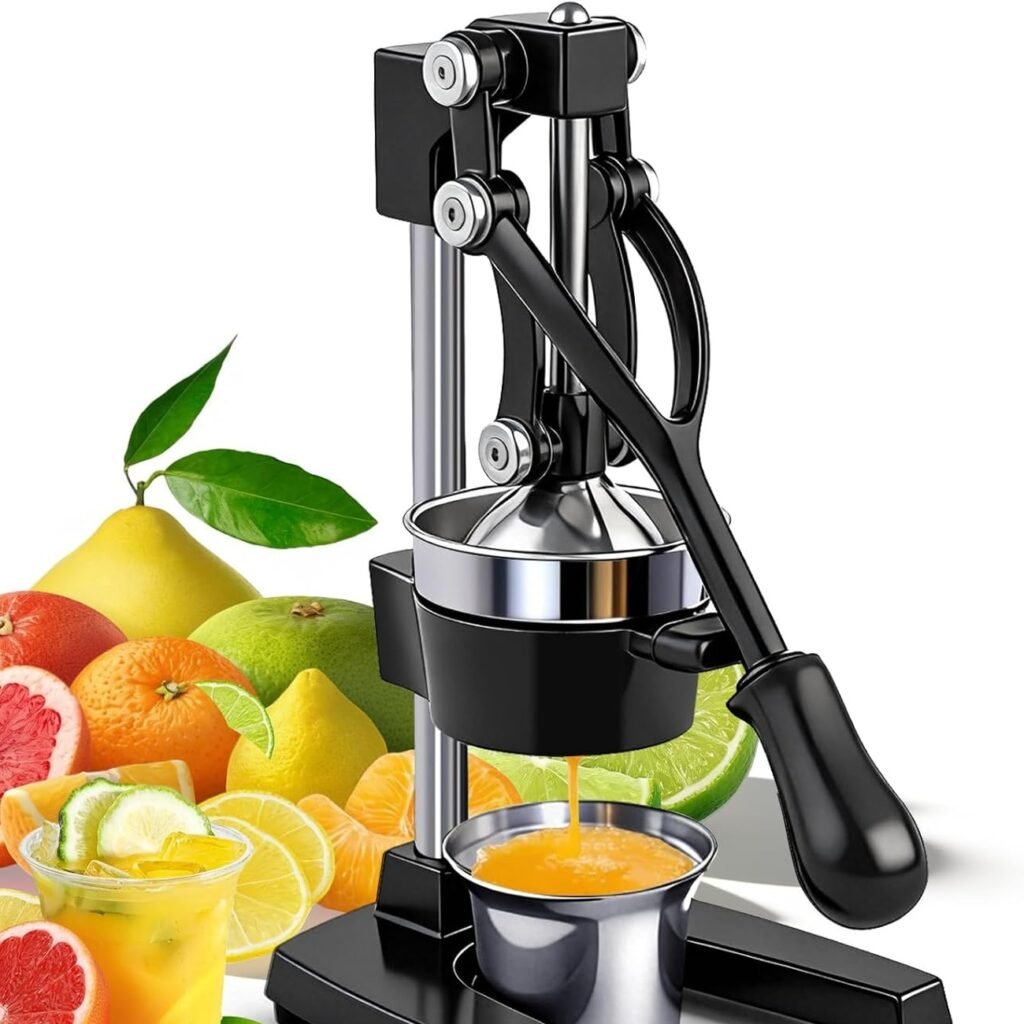
The Zulay Kitchen cast iron juicer is the model I’ve used daily for over a year, and it’s earned its place as the most-used tool in my kitchen. If you want the best cast iron juicer for home daily use — lime juice, lemon juice, morning orange juice — this is where I’d start.
What makes it stand out
The build quality is immediately obvious. Heavy-duty cast iron body, food-grade stainless steel bowl and filter cone, and a rubberized base that stays firmly planted even when pressing large grapefruits. In my testing, I compared the Zulay against two cheaper cast iron alternatives — the Zulay consistently extracted more juice per fruit, with cleaner separation of seeds and pulp.
The 5-inch bowl diameter handles everything from small limes to full-size grapefruits. I tested it on pomegranates too — it works remarkably well, producing pure pressed juice with no bitterness from the rind.
The leverage mechanism is the key differentiator. One smooth pull brings the pressing cone down with enough force to fully collapse the fruit half, extracting the last drop of juice. Cheaper models require multiple pulls or leave juice in the rind.
Honest drawbacks
It’s heavy — this is a solid piece of cast iron equipment, not a lightweight tool. For most countertop use that’s a feature (stability), but if you want something portable or easy to store in a drawer, this isn’t it. Users with wrist or joint issues may find the pressing motion tiring for large batches.
Specs:
- Material: Cast iron body, food-grade stainless steel bowl and filter
- Bowl diameter: 5 inches
- Fruits: Lime, lemon, orange, grapefruit, pomegranate
- Cleanup: All parts detachable, dishwasher safe
- Warranty: Lifetime Zulay guarantee
My rating: 4.7/5 ✅ Best for: Daily home use — lime juice, grapefruit juice, lemon juice, morning citrus routine
Cast Iron Juicer #2 — Commercial Manual Cast Iron Juicer for Grapefruit & Citrus
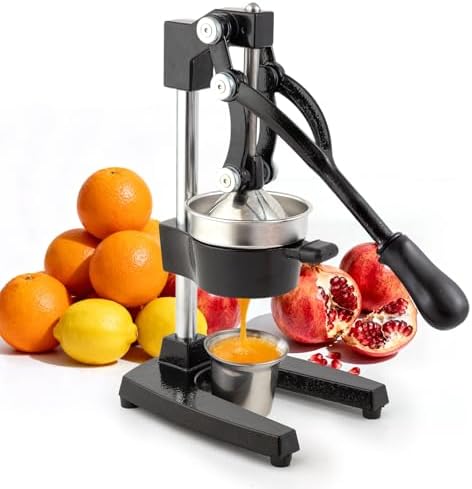
- 【DURABLE DESIGN】Crafted from heavy-duty cast iron, this manual juicer boasts a sturdy structure for long-lasting reliabi…
- 【EASY OPERATION】This hand-press citrus juicer is simple and quick to use: cut pomegranates or citrus fruits in half, pla…
- 【EFFORTLESS CLEANING】The juicer’s top pressing cone features a new twist-lock detachable design, allowing all fruit-cont…
- 【HIGH JUICE YIELD】 Compared to standard juicers, this lemon/citrus juicer delivers higher juice output. The lever struct…
- 【NOTES & WARRANTY】This manual juicer is large (30cm tall) and heavy (6.4kg), requiring more storage space and not design…
If your main goal is high-volume grapefruit juice or you want a more professional-grade cast iron juicer, this commercial model is the step up. It’s designed for restaurant and bar use but performs just as well at home for people who juice heavily.
What makes it stand out
The construction is entirely stainless steel on all contact surfaces, which means zero rust risk — critical when you’re dealing with the citric acid in grapefruit and lime juice on a daily basis. The base is heavier and wider than the Zulay, giving it exceptional stability even when pressing the largest grapefruits.
I tested this specifically on large grapefruits that the Zulay found slightly challenging, and the commercial press handled them cleanly with a single pull. If grapefruit juice is your primary goal, this is the more capable tool.
Cleanup is equally straightforward — all parts are removable and dishwasher safe, the stainless steel resists staining even from deeply pigmented fruits like pomegranates.
Honest drawbacks
Higher price point than the Zulay. Takes up more counter space. For someone who only needs lime juice or lemon juice from time to time, the Zulay is more than sufficient. This model justifies its cost if you’re making grapefruit juice for a family daily or running a small food business.
Specs:
- Material: Cast iron base, stainless steel throughout
- Best fruits: Grapefruit, orange, lemon, lime, pomegranate
- Use case: Home and commercial
- Cleanup: Removable parts, dishwasher safe
My rating: 4.5/5 ✅ Best for: Heavy grapefruit juice production, high-volume citrus pressing, professional use
Cold Press Juicer Machine — Best for Vegetables and Greens

- 【Upgraded Double-Press Technology】The 400W 55RPM juicer with upgraded double -press technology, not only can efficient f…
- 【Dual-Layer Microfilter Non-Clogging】This cold press juicer equipped with dual-layer microfilter for two filtering throu…
- 【5.3 Inch Extended Feed Chute】This masticating juicer with 5.3 inch large feed chute enough for whole vegetabels and fru…
- 【User-Firendly Operation】This juice extractor machine is easy to assemble in 3 steps and operate with one-button control…
- 【Safety Features & Protection】The materials used of this juicer machine are safe and BPA-free, which is an ideal choice …
For everything beyond citrus — vegetables, leafy greens, mixed fruits, wheatgrass — a cold press juicer machine is the right tool. While a cast iron juicer excels at lime juice and grapefruit juice, it physically cannot process carrots, kale, celery, or ginger. That’s where the slow juicer comes in.

- AMERICA’S #1 JUICE EXTRACTOR BRAND: This durable juicer is backed by a 3-year limited warranty from Hamilton Beach, the …
- COMPARE AND CHOOSE WITH CONFIDENCE: Compare the competition to our extra-large 3” chute, 800 watts of power, 80 oz. pulp…
- SAVE TIME AND EFFORT WITH EXTRA-LARGE 3″ BIG MOUTH CHUTE: Since the centrifugal juicer chute fits a whole apple, a bunch…
- MAXIMUM JUICE YIELD FROM HARD AND SOFT FOODS: This electric juicer has a 800 watt rated power motor that ensures maximum…
- EASY TO CLEAN: Cleaning up after using this fruit juicer machine is easy with the convenient strainer cleaning brush. Th…
What makes it stand out
The 5.3-inch feed chute is genuinely large — whole apples, full celery stalks, and large chunks of ginger go in without pre-cutting. This makes a real difference in daily use; pre-cutting produce is what kills most people’s juicing routines.
The double-press technology distinguishes this slow juicer from cheaper cold press models. Most masticating juicers press once — this one processes the pulp a second time, extracting significantly more juice from fibrous vegetables. In my testing with kale and celery, the yield was noticeably higher than single-press alternatives.
Running at 55 RPM, this cold press juicer machine generates almost no heat, which means the pressed juice retains maximum enzymes and nutrients. The juice also keeps for up to 72 hours refrigerated — far longer than centrifugal juice, which should be consumed immediately.
Honest drawbacks
Like all cold press juicer machines, cleanup takes a few minutes — there are multiple parts to disassemble and rinse. It’s also slow by nature: a full glass of vegetable juice takes 3–5 minutes compared to 30 seconds in a centrifugal machine. That’s the trade-off for quality.
Specs:
- Technology: Double-press masticating / slow juicer
- Feed chute: 5.3 inches
- Speed: 55 RPM
- Materials: BPA-free, food-safe
- Best for: Vegetables, leafy greens, mixed fruits, wheatgrass
My rating: 4.6/5 ✅ Best for: Daily vegetable juice, leafy greens, mixed pressed juice — maximum nutrition retention
Cold Press vs Centrifugal — A Clear Comparison
Understanding the difference between a cold press juicer machine and a centrifugal model helps you make the right investment. Here’s the honest breakdown:
Juice Quality
A cold press juicer machine — also called a slow juicer or masticating juicer — preserves more nutrients because it generates no heat. Centrifugal juicers spin at 6,000–14,000 RPM, creating friction and heat that degrades some vitamins and enzymes. For pressed juice you want to store or drink for its nutritional value, cold press wins.
Speed
Centrifugal juicers are faster — a glass of fruit juice in 30 seconds. A slow juicer takes 3–5 minutes for the same glass. For vegetables and greens, the slower pace is worth it. For quick fruit juice, centrifugal is practical.
Noise
Cold press juicer machines are nearly silent. Centrifugal juicers are loud — similar to a blender. If you juice early in the morning, this matters.
Versatility
Slow juicers handle everything: fruits, vegetables, leafy greens, wheatgrass, nuts (for nut milk), even herbs. Centrifugal juicers work best with fruits and hard vegetables — they struggle with leafy greens and produce very little juice from them.
Which to choose
- Choose a cold press juicer machine if you juice vegetables and greens regularly and care about nutrient quality
- Choose centrifugal if you juice fruit occasionally and want the fastest possible routine
Mia’s Complete Juicing Setup — What I Actually Use
After testing every combination, here’s what I genuinely use in my kitchen:
Morning citrus routine → Cast iron juicer (Zulay). Lime juice for hot water and lime every morning, done in 10 seconds, zero cleanup.
Weekly vegetable juice batches → Cold press juicer machine (5.3″ Large Feed Chute). Celery, kale, ginger, cucumber — one large batch that keeps for 48 hours.
Quick fruit juice → Centrifugal juicer when I want apple or carrot juice fast and don’t want to wait.
The cast iron juicer and the cold press juicer machine together cover 95% of what I need. If I had to choose just one for citrus: the cast iron juicer, no contest. If I had to choose just one for everything else: the slow juicer.
FAQ — Cast Iron Juicer, Cold Press & Citrus Pressing
What is the best cast iron juicer for grapefruit juice? For daily home use, the Zulay Kitchen cast iron juicer handles grapefruit well with its 5-inch bowl. For large grapefruits or high-volume pressing, the commercial cast iron juicer model (B0FVV883NN) provides more stability and power.
Is a cast iron juicer better than an electric juicer for lime juice? Yes — for lime juice specifically, a cast iron press extracts more juice faster, with zero heat, zero oxidation, and cleanup in 30 seconds. No electric juicer beats it for pure citrus efficiency.
What’s the difference between a slow juicer and a cold press juicer machine? They’re the same thing. “Slow juicer”, “cold press juicer”, and “masticating juicer” all describe the same type of machine — slow-speed extraction that generates no heat, preserving maximum nutrients in the pressed juice.
Can a cold press juicer machine make grapefruit juice? Yes, but it’s slower and harder to clean for citrus than a cast iron juicer. For grapefruit juice specifically, a cast iron press is faster, extracts more juice, and requires 30 seconds of cleanup versus 5 minutes for a cold press machine.
How long does pressed juice last? Cold press / slow juicer: 24–72 hours refrigerated. Cast iron citrus press: drink within a few hours for best freshness. Centrifugal: drink immediately — oxidation degrades it quickly.
Is the Zulay cast iron juicer hard to clean? Not at all. The stainless steel bowl and filter cone detach in seconds and are dishwasher safe. Full cleanup takes under a minute.
Final Verdict
For anyone serious about fresh juice in 2026, here’s the clearest recommendation I can give:
Best cast iron juicer for home daily use → Zulay Kitchen Cast Iron Juicer Perfect for lime juice, lemon juice, and morning citrus. Built to last a lifetime, backed by Zulay’s lifetime guarantee.
Best cast iron juicer for grapefruit juice & heavy use → Commercial Cast Iron Juicer (B0FVV883NN) More stability, more power, designed for large fruits and high-volume pressing.
Best cold press juicer machine for vegetables and greens → 5.3″ Large Feed Chute Cold Press Juicer The best slow juicer I’ve tested for daily mixed vegetable and fruit pressed juice.
Best for occasional quick fruit juice → Centrifugal juicer Fast, simple, affordable — perfect if you juice a few times a week and prioritize speed over nutrition.
You Might Also Like
- Want a full guide on the best juicer machines in 2026? → Best Juicer Machines 2026 for Healthy Juice at Home
- Looking for the best juicer specifically for vegetables and leafy greens? → Best Juicer Machines for Vegetables and Fruits 2026
- Building a complete healthy kitchen setup? → Best Non Toxic Cookware Set Stainless Steel 2026